Homeowners with damp on a chimney breast
Staining on the breast in a bedroom or on the ceiling near the stack, usually appearing or worsening after driving rain. The cause is almost always outside, on the stack or at the flashings.
Roofing & repointing across Lancashire & West Yorkshire
Chimney Work · Burnley & Lancashire
Repointing, rebuilds, flaunching and flashings that stop water running down the stack and into your bedroom wall, priced as one fixed figure after a proper look, not guessed at from the pavement.
Over 10 years on local stacks · £1 million public liability · free fixed-price quote with photographs of what we found
10+ years' experience
Repointing and stack work is a core trade here
£1m public liability
Insured for work at height on every job
Workmanship guarantee
Confirmed with your quote
Photographs provided
You see what we found before you spend anything
What it involves
A chimney stands clear of the roof and is weathered on all four sides plus the top. It fails faster than any other masonry on the building, and everything it lets in lands inside the roof space or on a bedroom wall.
Chimney work covers repointing the stack, rebuilding courses that have deteriorated beyond pointing, renewing the flaunching that holds the pots, replacing or re-dressing lead flashings and soakers at the base, capping disused flues and dealing with the damp that a failed stack has already caused. On the older housing across Burnley, Nelson, Colne and the Yorkshire valleys, most stacks are original and a great many have not been touched in decades.
The important thing is diagnosing which part has failed. Damp on a chimney breast can come from open mortar joints on the stack, from missing flaunching, from flashings that were sealed to the wall rather than chased into it, or from an unventilated capped flue. Fixing the wrong one is a waste of scaffold.
You get an inspection, photographs of the stack as it actually is, an explanation of what has failed and a fixed written price for putting it right, free of charge and with no obligation. Where a stack is genuinely beyond repair, taking it down and weathering the roof over is priced as an alternative.
Staining on the breast in a bedroom or on the ceiling near the stack, usually appearing or worsening after driving rain. The cause is almost always outside, on the stack or at the flashings.
Disused stacks still take the weather and still let water into the building. Repointing, correct capping and ventilation keeps them from becoming a damp problem, and removal is an option where the stack serves no purpose.
Perished stack mortar, cracked flaunching and defective flashings are standard survey findings. Priced and completed with a workmanship guarantee, they stop being a negotiating lever.
What happens if it waits
A chimney is a masonry column standing in the weather with a hole down the middle. Once the joints open and the flaunching cracks, rain has a direct route into the flue, into the brickwork and down inside the building, and it goes on doing it every wet day.
Water travelling down the flue and through saturated masonry appears as staining in bedrooms and lofts. Redecoration is wasted money until the stack itself is dealt with.
Moisture drawn through a stack carries salts from old soot deposits into the plaster. These bloom on the surface, blow the plaster and cannot be painted over; the plaster has to come off and be replaced.
Saturated masonry freezes and the faces of the bricks or stone spall away. What was a repointing job becomes a rebuild of several courses.
Loose flaunching and eroded joints mean pots and coping can come down in a gale: onto the roof, a garden, a pavement or a neighbouring property.
Water running down the outside of the flue reaches rafters and battens where the stack passes through the roof, rotting timber in the part of the loft least likely to be inspected.
Stack work usually needs scaffold. Dealing with the pointing, flaunching and flashings in one visit costs far less than paying for access twice because only half the problem was priced.
Stacks are one of the few parts of a roof where the damage is almost always visible from inside the house before anyone looks outside. If there is staining on a chimney breast, the stack is the place to start.
Our process
The stack is assessed properly: joints, brick or stone faces, flaunching, pots, capping, and the flashings and soakers where it passes through the roof. Photographs are taken throughout.
You are told which element has failed and why the damp is appearing where it is, so money goes on the actual cause rather than the most visible symptom.
A written fixed-price quote covering access, materials and each element being dealt with: pointing, flaunching, flashings, rebuild or removal. Free and with no obligation.
Access set up safely, joints raked out and repointed, courses rebuilt where needed, flaunching renewed around the pots and lead flashings dressed and chased in properly.
Everything checked over, debris cleared from roof and gutters, photographs of the completed stack provided, and a workmanship guarantee confirmed with your quote.
What you get
The stack, the flaunching and the flashings are dealt with as one system, so the water stops entering rather than moving to a different route in.
Re-bedded pots, renewed flaunching and sound joints remove the risk of material coming down off the highest point of the building.
Flashings chased into a joint and dressed to the roof, not stuck to the wall with sealant, the difference between a repair that lasts and one that returns.
Pointing, flaunching and flashing handled on the same access, so you are not paying for scaffold twice in three years.
Photographs before and after mean you can see the condition of a stack you will never get close to yourself.
The price agreed in writing is the price paid, and the finished job carries a workmanship guarantee.
Recent work
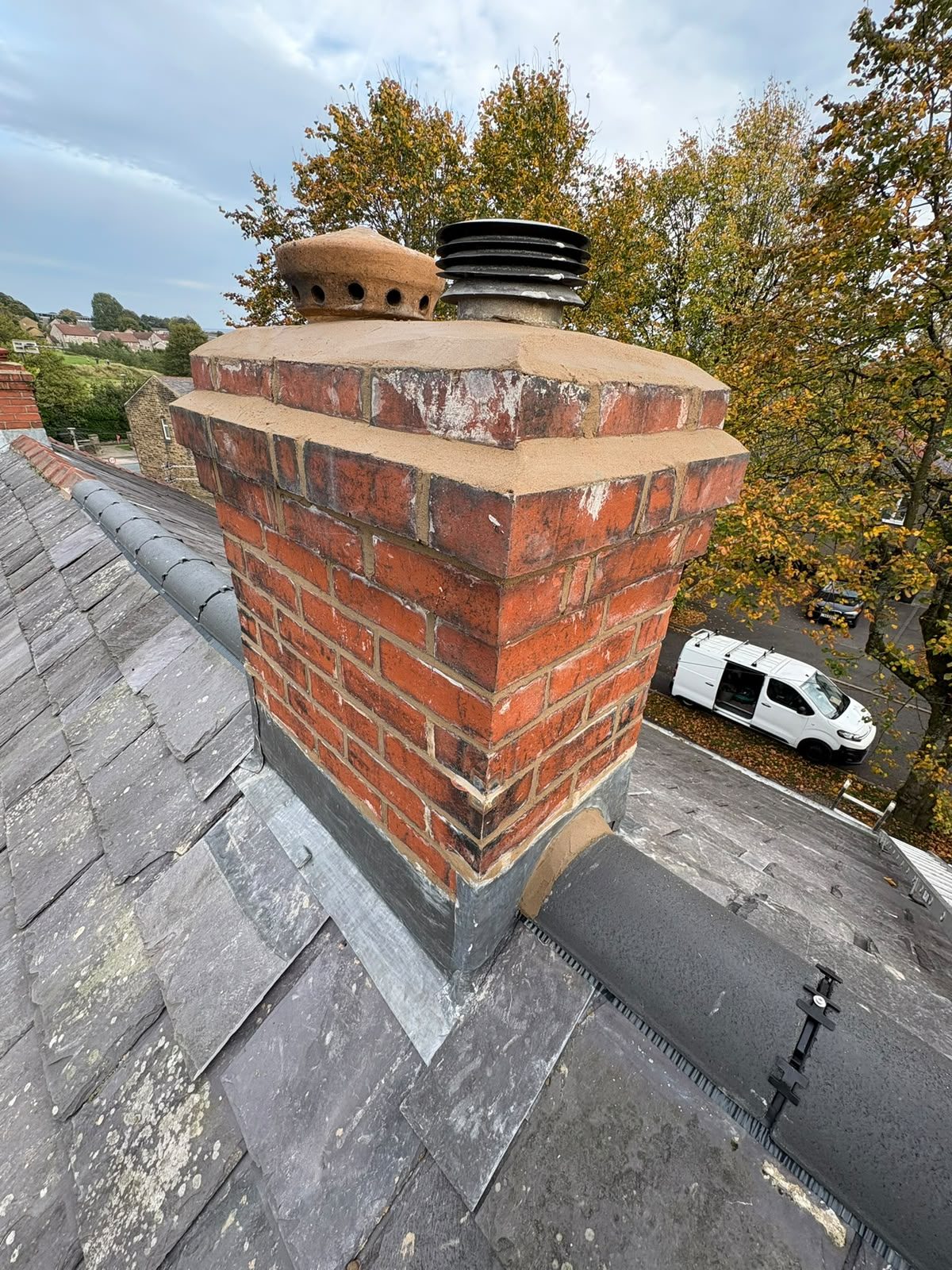
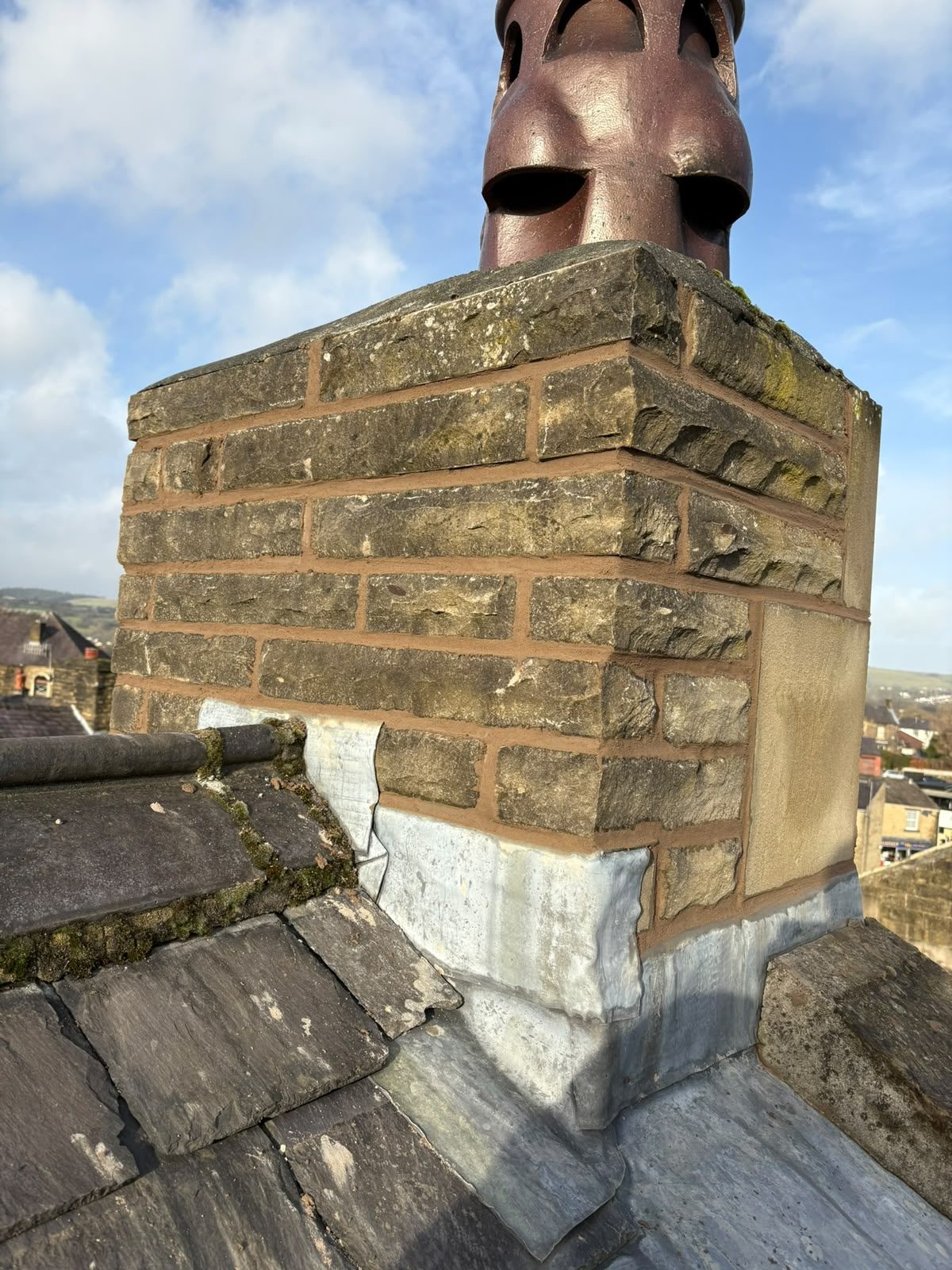
In detail
Stacks fail in a predictable order: flaunching, then joints, then faces, then flashings. Here is what each element does and what putting it right involves.
Perished joints are raked out to a sound depth and repointed with a mix matched to the masonry. On the soft stone and old brick common across East Lancashire, a weaker mix is correct; a hard modern cement traps moisture and spalls the faces off the brick.
Because the stack is weathered on every face, repointing is done all the way round rather than just the elevation facing the prevailing weather, which is where a cheap price usually cuts the corner.
Flaunching is the sloped mortar cap on top of the stack that holds the pots and sheds water off the top. It cracks and breaks up with age, and once it does, rain runs straight into the top of the stack.
Renewal means removing the old flaunching, checking the pots are sound and re-bedding them, then forming a new cap with a proper fall so water runs off the edge rather than sitting on the top.
Where frost has destroyed the brick faces or the stack has begun to lean, pointing is not enough. The affected courses are taken down and rebuilt, reusing sound material where possible and matching what is there.
Full rebuilds above the roof line, and complete removal with the roof made good over the opening, are both priced where the stack serves no purpose and is not worth maintaining.
Where the stack passes through the roof it is weathered with lead: front apron, side soakers with step flashings, and a back gutter behind the stack. Each of those has to be dressed properly and chased into a raked joint, wedged and pointed.
The back gutter is the part that fails most and is hardest to see. It carries water round the uphill side of the stack, and when it fails the water goes directly onto the roof timbers.
A capped chimney still needs to breathe. Sealing a flue completely traps moisture inside the stack, which then shows as damp on the breast below. Capping is done with a ventilated cowl or vented cap so air can still move.
Where a stack is being removed instead, the roof is closed up with matching covering, new membrane and battens, and the ridge or slope made good so the repair does not read as a patch.
Most stack work is domestic: terraces, semis and detached property with original chimneys, often shared party stacks on terraced streets where access and neighbour agreement need arranging in advance.
Commercial and rental property is also covered, including older shop and mill conversions where stacks are decorative but still let water into the building if left.
Based near BB8 0JP, this work is carried out across East Lancashire and West Yorkshire, from stone terraces in Burnley and Colne to hillside properties around Skipton and Keighley.
Most roofs need more than one thing looking at. These jobs are often quoted alongside chimney work.
Straight answers
Anything not covered here, ring Samuel on 07534 748896 and ask. You will get a straight answer rather than a sales pitch.
It depends on the size of the stack, how much of it has failed, and whether scaffold or a tower is needed to reach it safely. Samuel inspects it, photographs it and gives you a fixed price in writing, free of charge.
Usually because water is entering outside: open mortar joints, cracked flaunching, defective lead flashings or an unventilated capped flue. Treating the plaster internally without fixing the stack simply moves the problem along.
Repointing and flaunching renewal on a typical domestic stack is often a matter of a day or two once access is in place. Rebuilds take longer. The expected duration is set out with your quote.
Often, yes, safe access to a stack usually needs proper scaffold or a tower, and that is included in the fixed price rather than added later. Where a stack can be reached safely without it, you will not be charged for it.
A correctly raked-out and correctly mixed repoint on a sound stack lasts many years. What shortens its life is a mix that is too hard for the masonry or work skimmed over failed mortar, neither of which we do.
Yes. A disused stack can be taken down above the roof line and the roof made good with matching covering, new membrane and battens. It is priced against repairing and capping it so you can compare the two.
Capped, but ventilated. A vented cowl or cap keeps rain out while letting the flue breathe, which prevents the trapped moisture that causes damp on the breast below.
Yes: aprons, soakers, step flashings and back gutters are renewed in code-appropriate lead, chased into a raked joint and pointed, not sealed to the wall face with mastic.
Public liability insurance up to £1 million is in place, and every job carries a workmanship guarantee confirmed with your quote.
Across East Lancashire and West Yorkshire from BB8: Burnley, Nelson, Colne, Clitheroe, Blackburn, Accrington, Preston, Skipton, Keighley, Bradford, Halifax, Leeds and Huddersfield.
If there is staining on a chimney breast, the answer is on the roof. Send your postcode and Samuel will inspect the stack, photograph it and price the work as one fixed figure.
Send your postcode and a short description of the job. Samuel will arrange a look and price it properly.
Free, no-obligation quote. Your details are only used to price and discuss your job. Prefer to talk? Call 07534 748896.