Owners of a roof past repairing
Repeated slips across several slopes, widespread nail failure, sagging lines, or a fourth repair in three winters. At that point re-covering costs less over ten years than the run of call-outs it replaces.
Roofing & repointing across Lancashire & West Yorkshire
Re-Roofing · Burnley & Lancashire
A stripped, re-membraned, re-battened and re-covered roof with correctly bedded ridges and verges, one fixed price agreed before the scaffold goes up, and decades of not thinking about your roof afterwards.
Over 10 years re-covering local roofs · £1 million public liability · fixed price in writing before any tile comes off
10+ years' experience
Full strip and re-cover work across the North West
£1m public liability
Insured throughout, scaffold to finish
Workmanship guarantee
Confirmed with your quote
Fixed price, not day rate
The figure quoted is the figure paid
What it involves
A re-roof is the one job where everything hidden gets put right at the same time: membrane, battens, fixings, ridges, verges and flashings. Done properly it resets the clock on the whole covering; done cheaply it repeats the same failures in a decade.
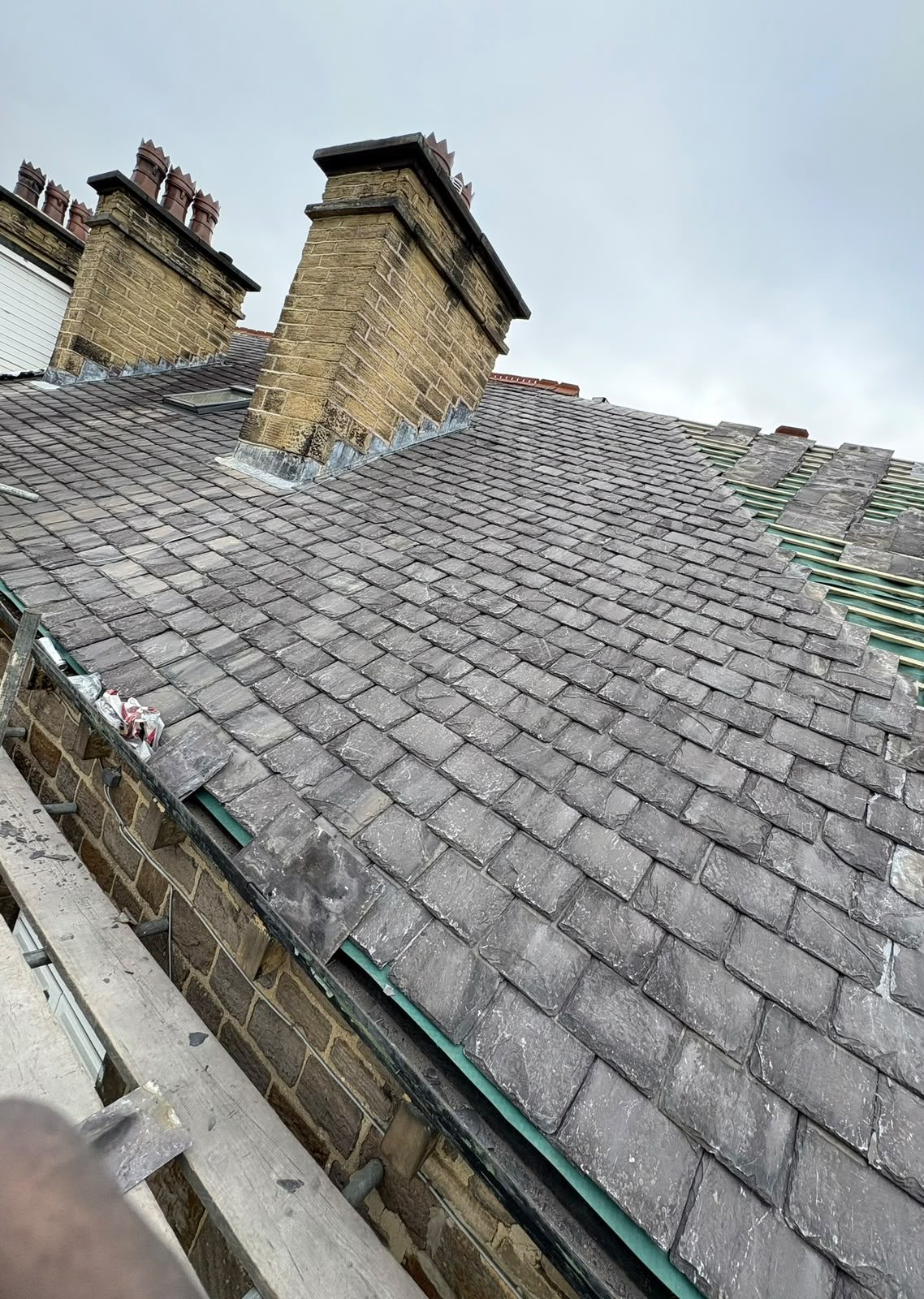
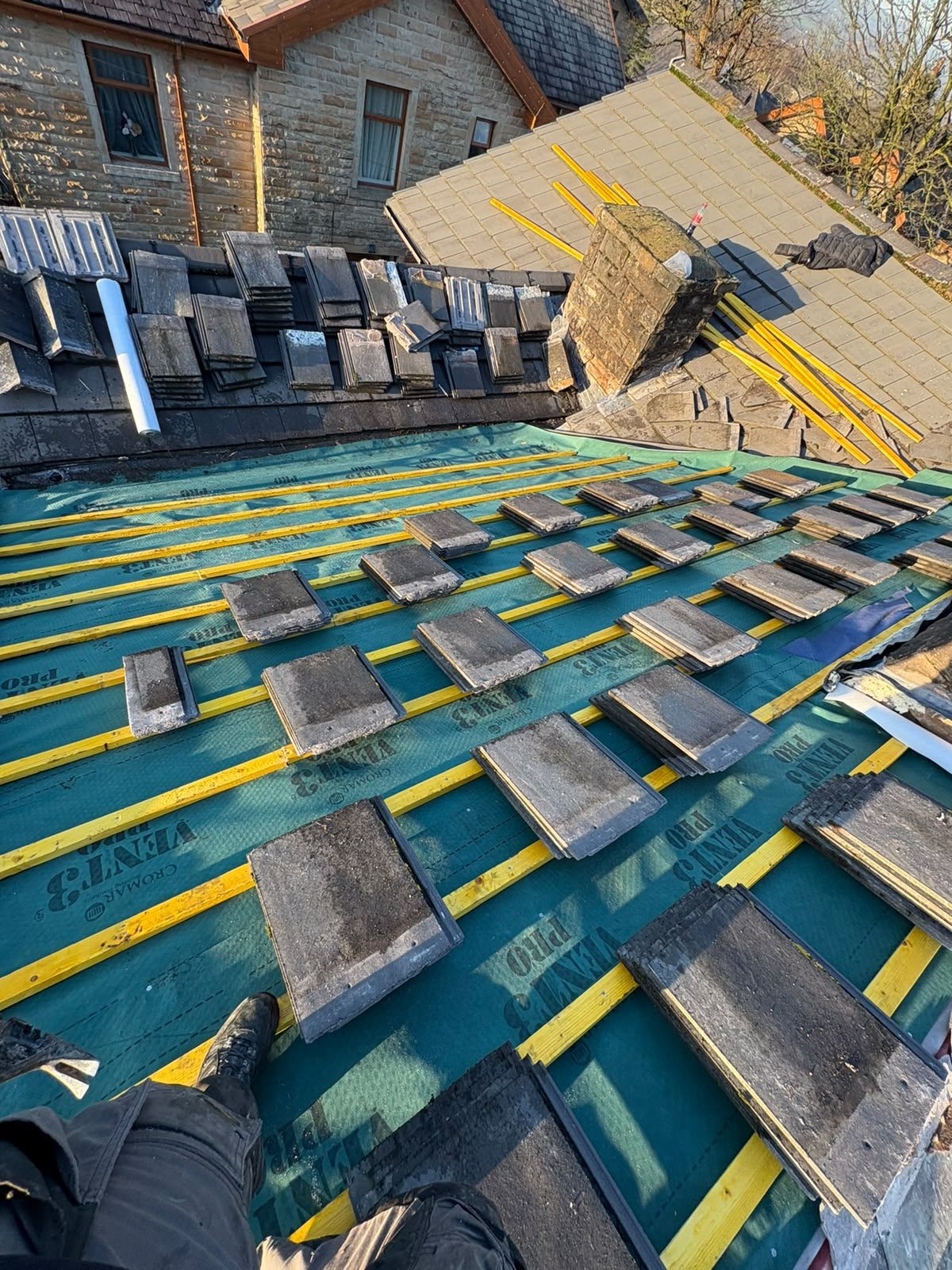
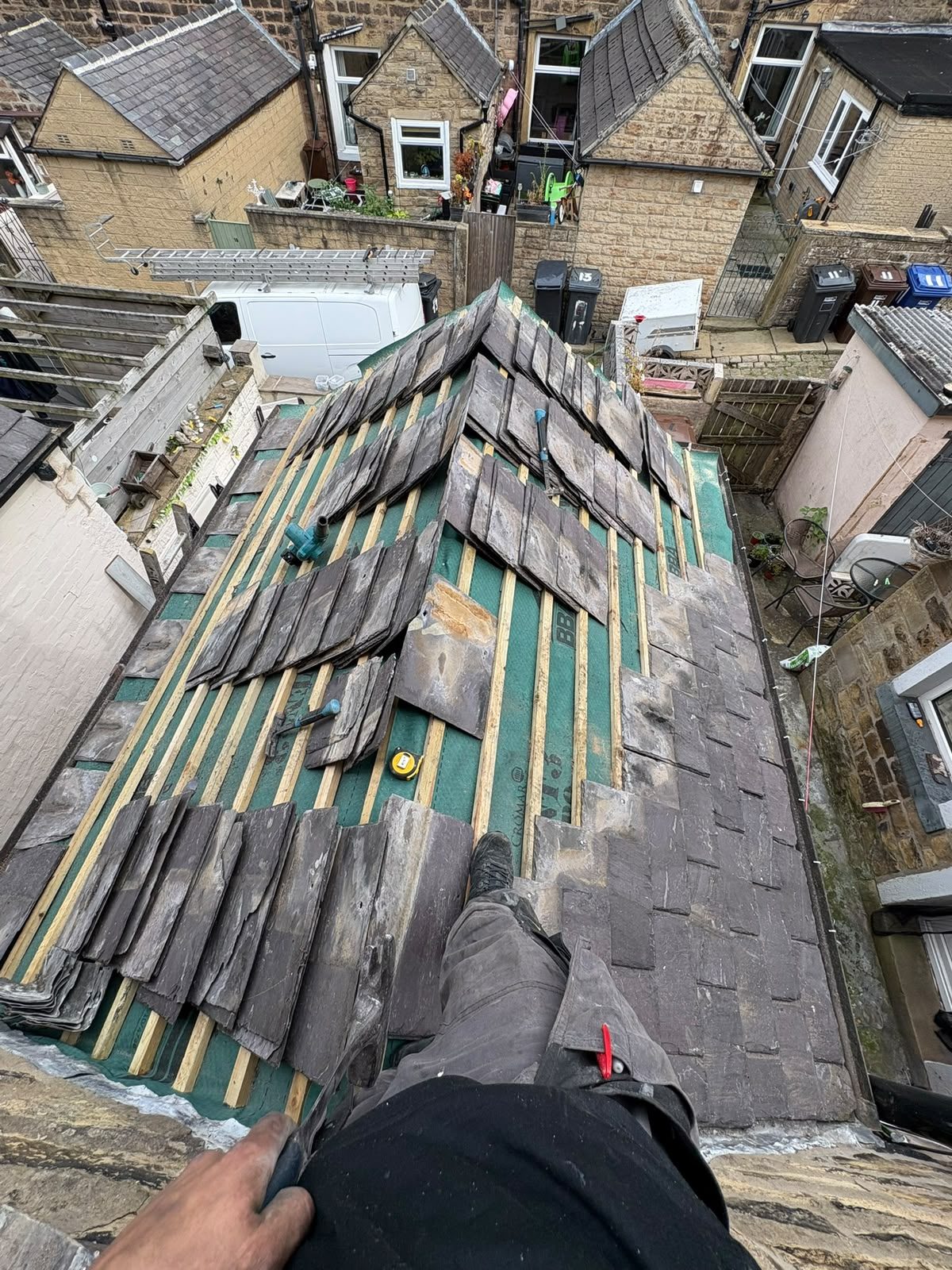
Re-roofing means stripping the existing covering back, checking and repairing the timber structure beneath, laying a new breathable underlay, fitting new treated battens and re-covering with slate or tile, either the original material carefully set aside and reclaimed, or new stock matched to the property. Ridges, hips and verges are then bedded or dry-fixed, and flashings around chimneys and abutments renewed as part of the job.
Most of the roofs we re-cover around Burnley, Nelson, Colne, Blackburn and over towards Keighley and Bradford are between 80 and 120 years old. The slate itself is often still sound; it is the nails, the sarking felt and the mortar that have given up. That is why a strip and re-cover, reusing sound slate where the quality allows, is frequently better value than importing an entirely new covering.
You get one fixed price covering scaffold, strip, disposal, materials, labour and finishing details, agreed in writing before anything starts. If the timber turns out to need more attention once the roof is open, that is discussed and agreed with you before it is carried out, not added quietly to a bill at the end.
Repeated slips across several slopes, widespread nail failure, sagging lines, or a fourth repair in three winters. At that point re-covering costs less over ten years than the run of call-outs it replaces.
Properties being refurbished, extended or brought back into use, where the roof needs bringing up to a modern standard of insulation, ventilation and weatherproofing at the same time as the rest of the work.
A failing roof drags on a survey and on a price. A completed re-cover with a workmanship guarantee is a straightforward answer to a surveyor's caveat.
What happens if it waits
A roof at the end of its life does not fail neatly in one go. It leaks in a new place each storm, and each of those leaks quietly adds to the eventual bill for timber, plaster and insulation long before the covering is finally replaced.
Once the underlay has perished, rain reaches battens and rafters directly. Rot spreads at rafter feet and along wall plates, and structural repairs are the most expensive part of any re-roof.
Three or four call-outs a year on a roof with failed fixings is money spent on a covering that is going to be stripped anyway. None of it counts towards the eventual job.
Wet insulation and an unventilated, damp roof space push heating costs up through every cold month, on top of the damage the moisture is doing above the ceiling.
Slates coming off an unstable roof onto a pavement, a shared yard or a neighbour's car is a genuine liability, particularly on terraced streets and rental property.
Buyers' surveyors flag failing coverings hard. Deals get renegotiated, delayed or lost, usually for a figure well above what the work would actually have cost.
A roof that finally goes mid-storm has to be dealt with at short notice, in bad weather, with scaffold arranged urgently. Planned work is always the cheaper way to buy the same roof.
A re-roof is a considered purchase, and it should be treated like one: a proper inspection, a clear written specification, a fixed price, and an honest conversation about whether the roof genuinely needs it yet.
Our process
The full roof is assessed: covering, fixings, membrane condition, timber, ridges, verges, flashings and rainwater goods, inside the loft as well as outside where access allows.
You get a written fixed price setting out the materials, the details being renewed and what is included: scaffold, strip, disposal, membrane, battens, covering and finishing. Free, with no obligation.
Scaffold erected, covering stripped and removed from site, sound slate set aside for reuse where it is worth reclaiming. Timber is checked properly with the roof open, and anything needing attention is agreed with you before it is done.
New breathable membrane, new treated battens set to the correct gauge, covering re-laid and fixed to suit the exposure of the site, then ridges, hips and verges bedded or dry-fixed and flashings renewed.
Roof checked over, gutters cleared, scaffold removed and the site left clean. The completed work carries a workmanship guarantee confirmed with your quote.
What you get
New membrane, battens, fixings and correctly detailed ridges and verges mean the roof is sound as a system, not just tidy on the surface.
A strip is the only time defective timber, missing ventilation and failed flashings can all be seen and put right at once, while the scaffold is already up.
Scaffold, strip, disposal, materials and labour in a single written figure agreed before work starts, with any structural findings discussed before they are actioned.
A properly ventilated roof space with dry insulation stops the heat loss and condensation that come with a perished, leaking covering.
A completed re-cover with a workmanship guarantee removes one of the biggest single objections in a house sale.
Samuel quotes the job and works on it, with one regular worker and trusted trades only where a larger job needs them, no rotating subcontract crews.
Recent work
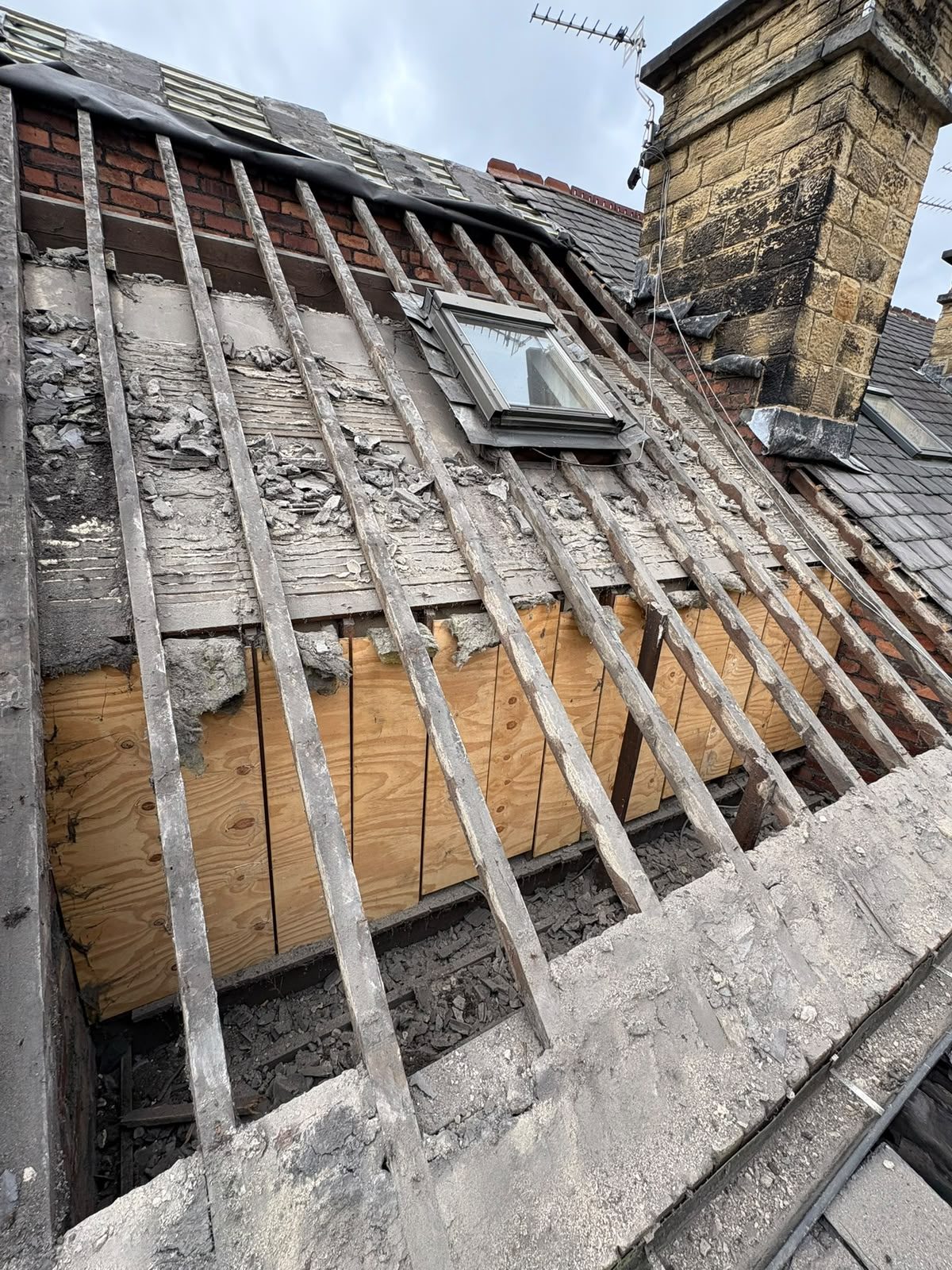
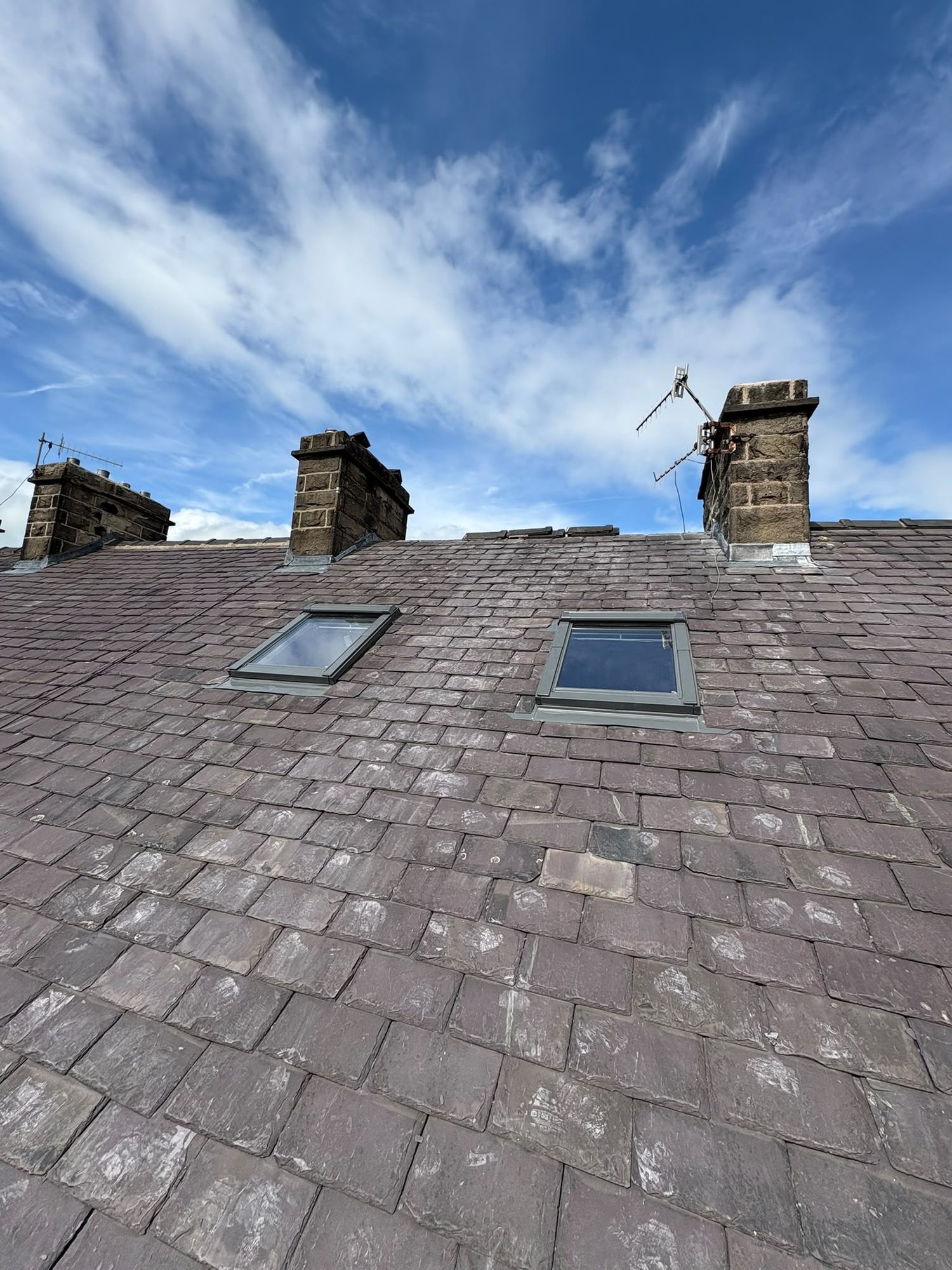
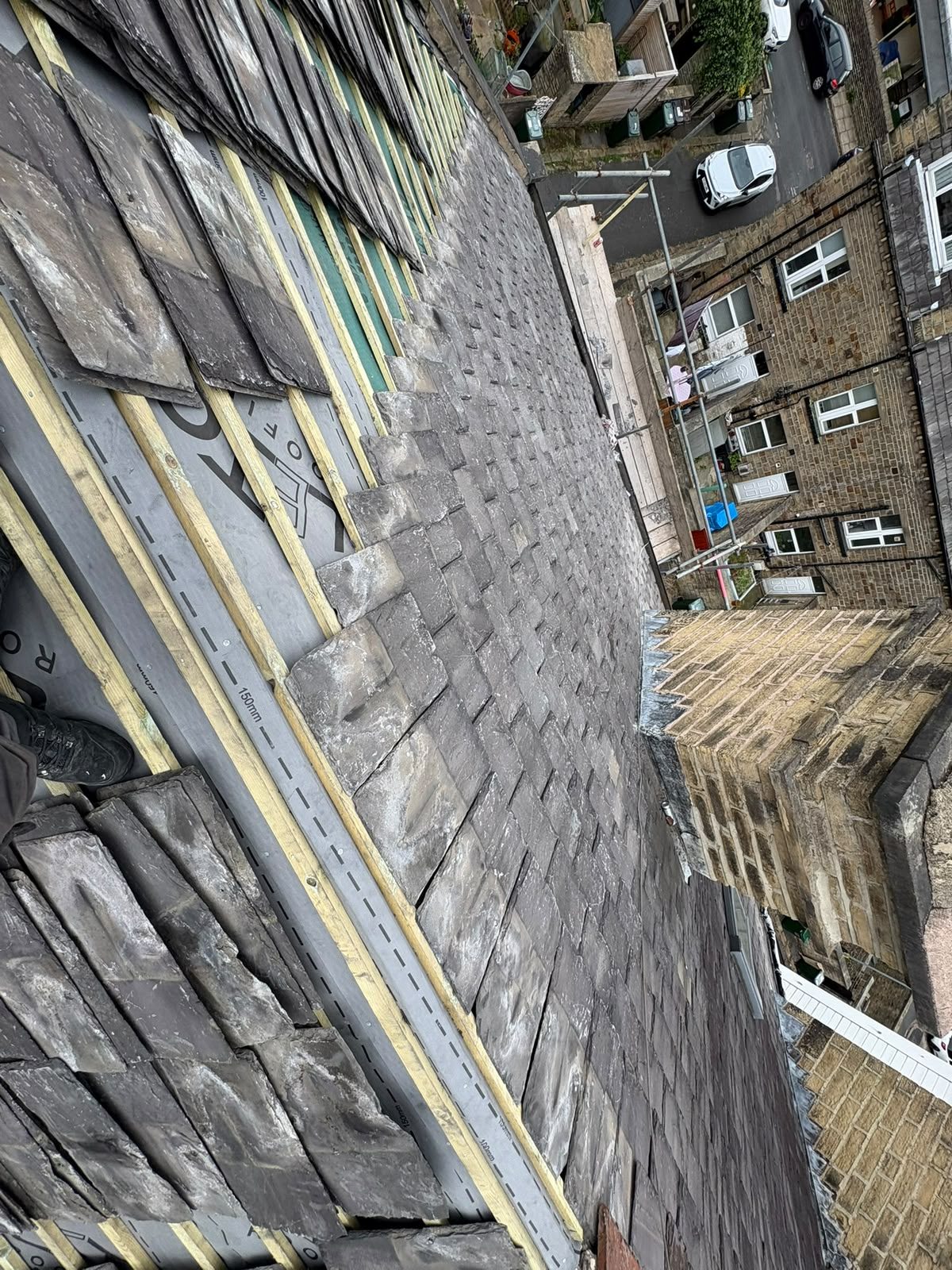
In detail
Re-roof quotes vary wildly because they cover very different amounts of work. Here is what the job involves, what the material choices mean and where the money genuinely goes.
Natural slate suits the majority of older property across East Lancashire and the Yorkshire side, and it is what most of these houses were built with. Welsh and Spanish slate are both used; the difference is in thickness, consistency and cost, and the choice is discussed against your budget rather than decided for you.
Sound slate stripped from the roof can often be reclaimed and re-laid, with new slate making up the shortfall. On a roof where the slate has begun to delaminate or shear at the nail holes, reclaiming is a false economy and that will be said plainly at quoting stage.
Interlocking concrete tiles are the most economical re-cover and shed water well on medium and low pitches, provided the structure can carry the weight. Clay plain tiles and pantiles suit properties where appearance matters or planning expects a match to neighbouring roofs.
Tile choice affects batten gauge, fixing pattern and ridge detail, all of which are set out in the quote rather than left as an assumption.
Modern breathable membrane replaces the old bitumen sarking felt, allowing moisture vapour out of the roof space while keeping wind-driven rain out. Combined with eaves and ridge ventilation it makes a substantial difference to condensation in the loft.
Battens are new, treated and gauged to the covering. Fixings are specified for the exposure of the site, hillside and open positions around Clitheroe, Skipton and the moor edges need more fixing and clipping than a sheltered mid-terrace in town.
Ridges and hips are either bedded in a correctly specified mortar mix or fitted with a dry-fix system that fixes mechanically and ventilates the ridge line. Dry systems remove the mortar failure that causes most ridge call-outs later on.
Verges are finished with dry verge units or bedded and pointed to match the property. This is the most exposed edge of any roof and the usual starting point for wind damage, so it is worth doing properly.
Scaffold is arranged as part of the job and priced in. Terraced streets need access and parking thought through in advance, and neighbours are worth speaking to before the work starts; we will tell you what to expect and when.
Old covering is removed from site rather than left in a heap, gutters are cleared of debris at the end, and the area is swept down before the scaffold comes away.
Domestic re-roofs, including terraces, semis, detached houses, bungalows, dormers and extensions, are the bulk of this work across Burnley, Nelson, Colne, Accrington, Blackburn and Preston.
Smaller commercial pitched roofs, workshops, garages and rental blocks are also covered, with the programme agreed around occupancy and access before the job is booked in.
Based near BB8 0JP, this work is carried out across East Lancashire and West Yorkshire, from stone terraces in Burnley and Colne to hillside properties around Skipton and Keighley.
Most roofs need more than one thing looking at. These jobs are often quoted alongside re-roofs.
Straight answers
Anything not covered here, ring Samuel on 07534 748896 and ask. You will get a straight answer rather than a sales pitch.
It depends on the size and pitch of the roof, the covering chosen, the scaffold required and what the timber is like underneath. Rather than quote a misleading average, Samuel inspects the roof and gives you a fixed price in writing covering the whole job, free of charge and with no obligation.
A typical terraced or semi-detached roof is usually a matter of days rather than weeks once scaffold is up, though weather affects it and larger or more complicated roofs take longer. An expected duration is given with your quote.
No. The house stays liveable throughout. It is noisy during the strip, and the roof is covered and made secure at the end of each working day.
Yes. Scaffold, strip, disposal of the old covering, materials, labour and the finishing details are all set out in one fixed price so there are no separate bills arriving afterwards.
A properly executed re-cover with new membrane, battens and correct fixings is a long-term investment measured in decades rather than years, with the exact expectation depending on the covering chosen. Ridge and verge mortar remains the part most likely to need attention first, which is why dry-fix options are worth discussing.
Often, yes. Sound slate is set aside during the strip and re-laid, with new slate making up the shortfall. Where the slate has delaminated or is shearing at the nail holes, reusing it would not be honest value and you will be told that at the quote stage.
Every job carries a workmanship guarantee, confirmed with your quote, and the business carries public liability insurance up to £1 million.
Like-for-like re-covering on a domestic property is normally treated as repair rather than development. Where a project involves changing the covering type, altering the structure or a listed or conservation-area property, the requirements are discussed before work is booked.
Yes. Dry-fix ridge and verge systems are mechanically fixed and ventilated, which removes the mortar failure that brings people back to ridges and verges years later. Both bedded and dry-fix options can be priced so you can compare them.
Across East Lancashire and West Yorkshire from the BB8 area: Burnley, Nelson, Colne, Clitheroe, Blackburn, Accrington and Preston, through to Skipton, Keighley, Bradford, Halifax, Leeds and Huddersfield.
A re-roof should be quoted after a proper inspection, not over the phone. Send your postcode and Samuel will come out, assess the covering and timber, and give you one fixed price for the whole job.
Send your postcode and a short description of the job. Samuel will arrange a look and price it properly.
Free, no-obligation quote. Your details are only used to price and discuss your job. Prefer to talk? Call 07534 748896.